Madewell Just Turned a 19th-Century Carriage Factory Into Its Newest Store
The brand's ninth New York-area location, in Brooklyn's Cobble Hill, keeps the timber beams and wood ceiling of the building's original life as a carriage, then belt, factory, and adds a dedicated men's shop built around the same workwear instincts.
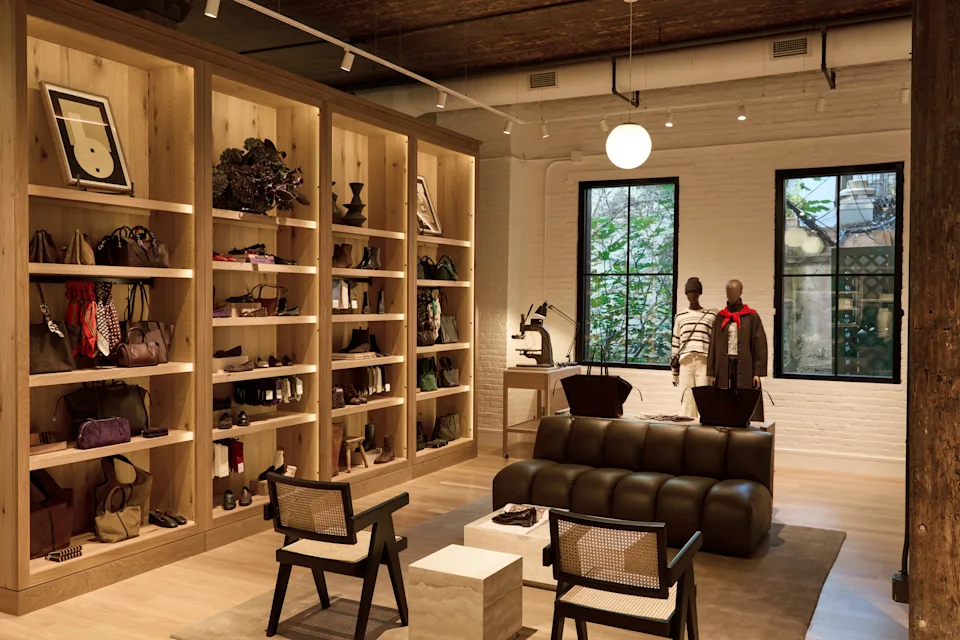
Madewell opened its second Brooklyn store on Wednesday, a 4,500-square-foot space at 51 Bergen Street in Cobble Hill, and it's the kind of building most retailers would gut on day one. Instead, Madewell kept it: the ground floor of what was a horse-drawn carriage factory in the 1800s and later a belt factory still has its timber post-and-beam columns and tongue-and-groove wood ceiling, with an open, loft-like layout built around the original structure rather than over it. It's the brand's ninth store in the New York City area, which at this point is less an expansion than a neighborhood-by-neighborhood victory lap.
The store includes a dedicated men's shop with custom fixtures inspired by traditional woodworking, a design choice that's doing double duty: it matches the building's own carpentry history while reinforcing Madewell's pitch that its workwear roots are structural, not seasonal. "Cobble Hill embodies so much of what we love about New York," said Garrett Putney, senior vice president of Madewell Stores, who added that the goal is for shoppers to "discover their next favorite pair of jeans." Opening weekend came with the usual flourishes, an exclusive Cobble Hill denim tote, custom New York-themed patches, and live illustrated portraits, nice enough touches, but not the reason this store matters.
The reason is the block it's on. Cobble Hill's retail strip already includes Warby Parker, Aesop, Eileen Fisher, Clare V., and Talea Beer, which makes this less a standalone opening than Madewell buying its way into a cluster of brands that have already done the work of training the neighborhood to shop there. That's a cheaper, faster path to foot traffic than building a destination from scratch, and it's the same math a lot of direct-to-consumer darlings have been running for years once they finally admit a website isn't a storefront.
Source: WWD
Kyle Duford, Founder & Editor, BRNDWIRE. More from Kyle →
The Brand Briefing
Liked this? Get five more every morning.
The Brand Briefing: the stories moving brands, in your inbox at 7am your time. Free.