What Really Went Wrong at Rapha
Rapha posted its only profitable year in 2017, the same year the Walton family paid a reported £200m for it, and it has lost money every year since. The price tag demanded growth, and growth cost Rapha the scarcity that justified the price.
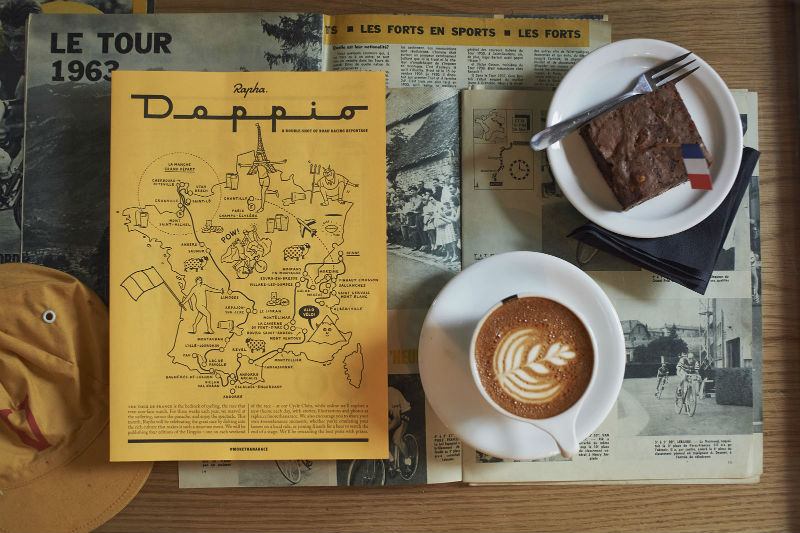
In July of 2010, on a hot day in New York, I wandered into a little coffee shop in NoLiTa, a funky little neighborhood in the city. Through the window I could tell it had a vibe, and the TVs were showing the Tour de France, a summer ritual watch of mine. So I stepped inside, into a cycling world I had never seen before, and ordered a doppio and a water.
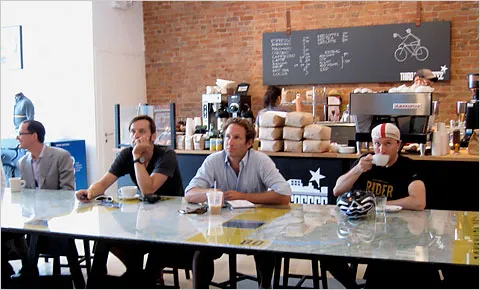
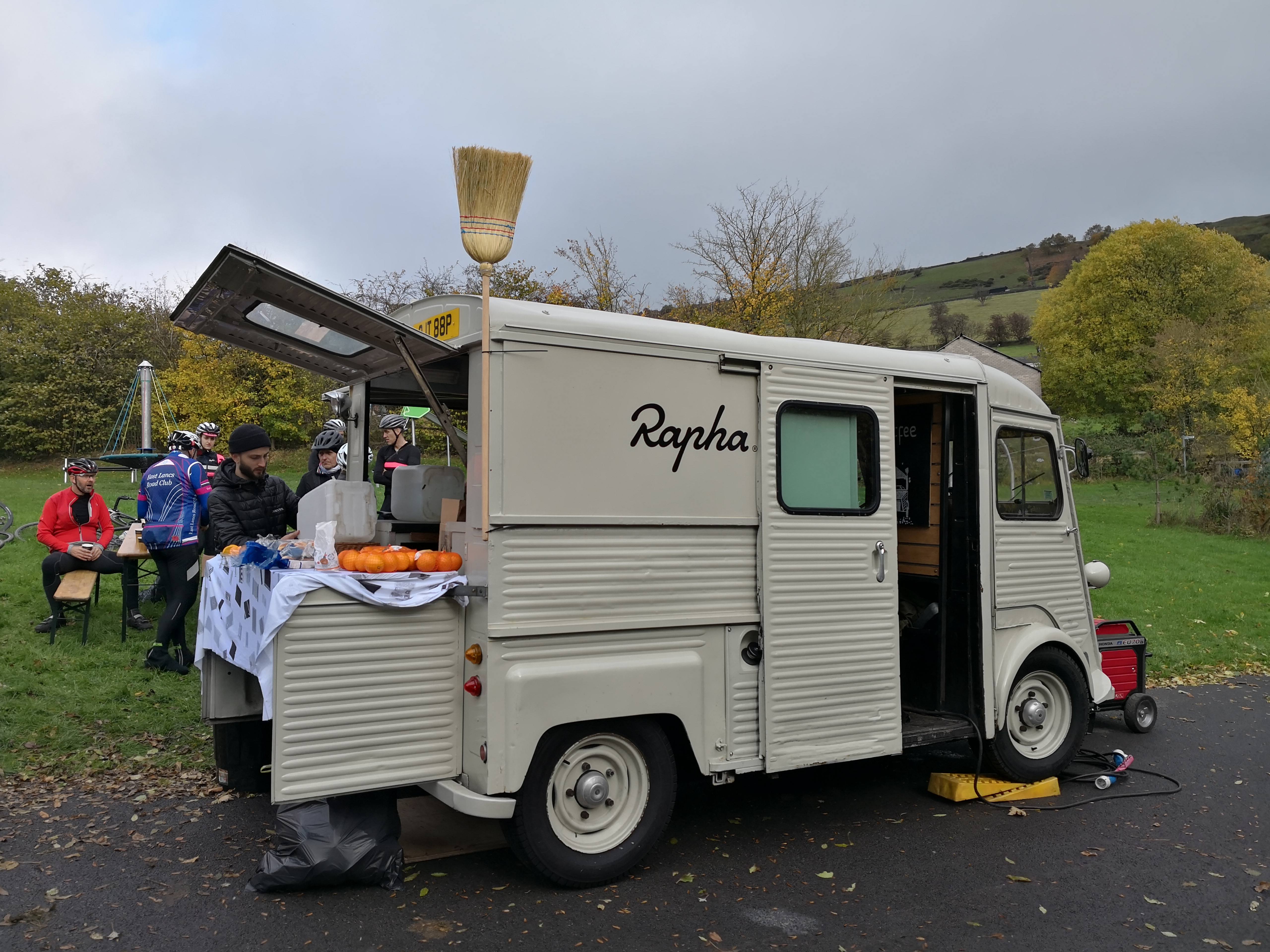
I sat at a large communal table with maps of the Tour and cycling paraphernalia under the glass top. After my espresso I walked the shop. A retro Citroën H Van was parked inside, stocked with a few garments of cycling kit, like a food truck for people who suffer on purpose.
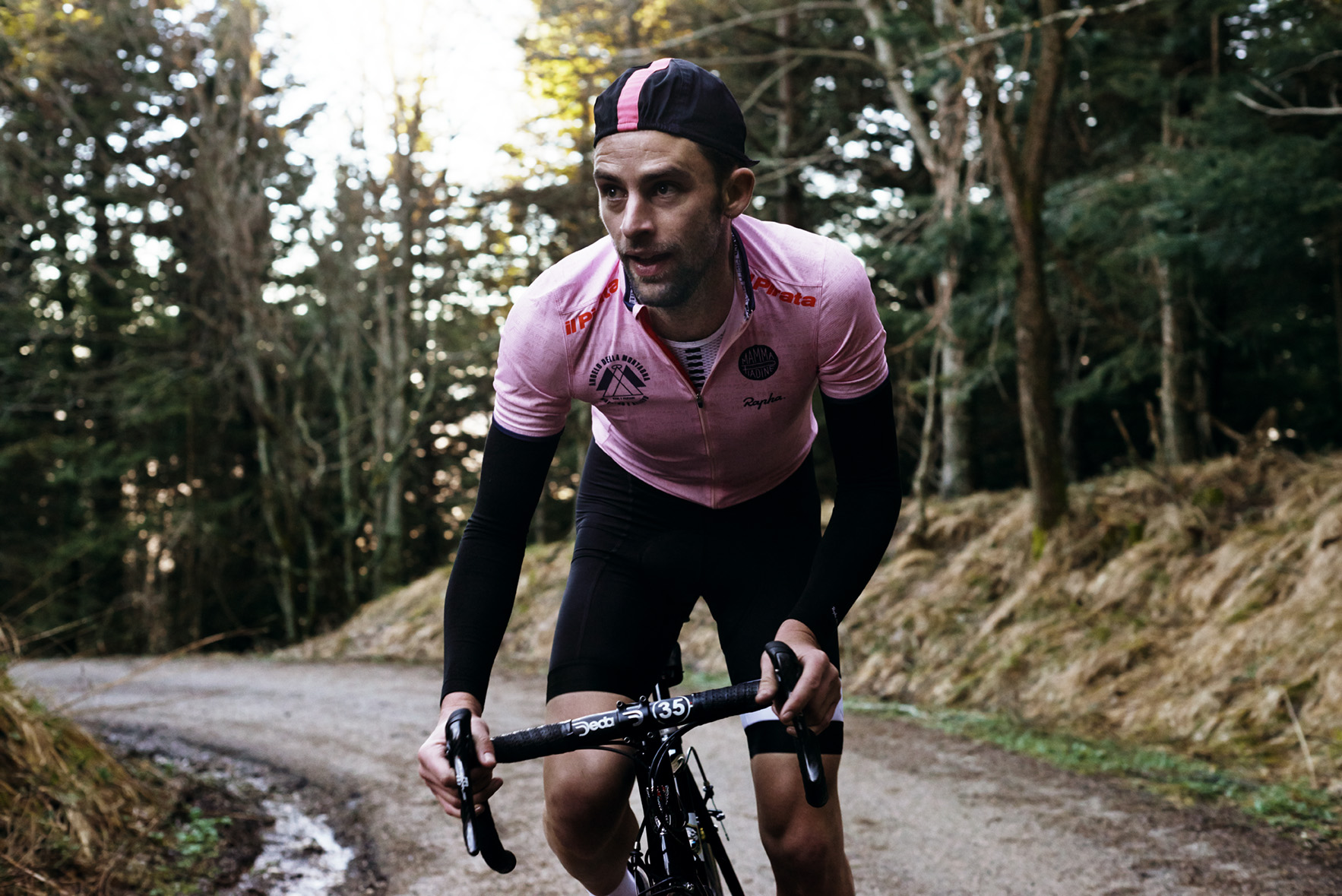
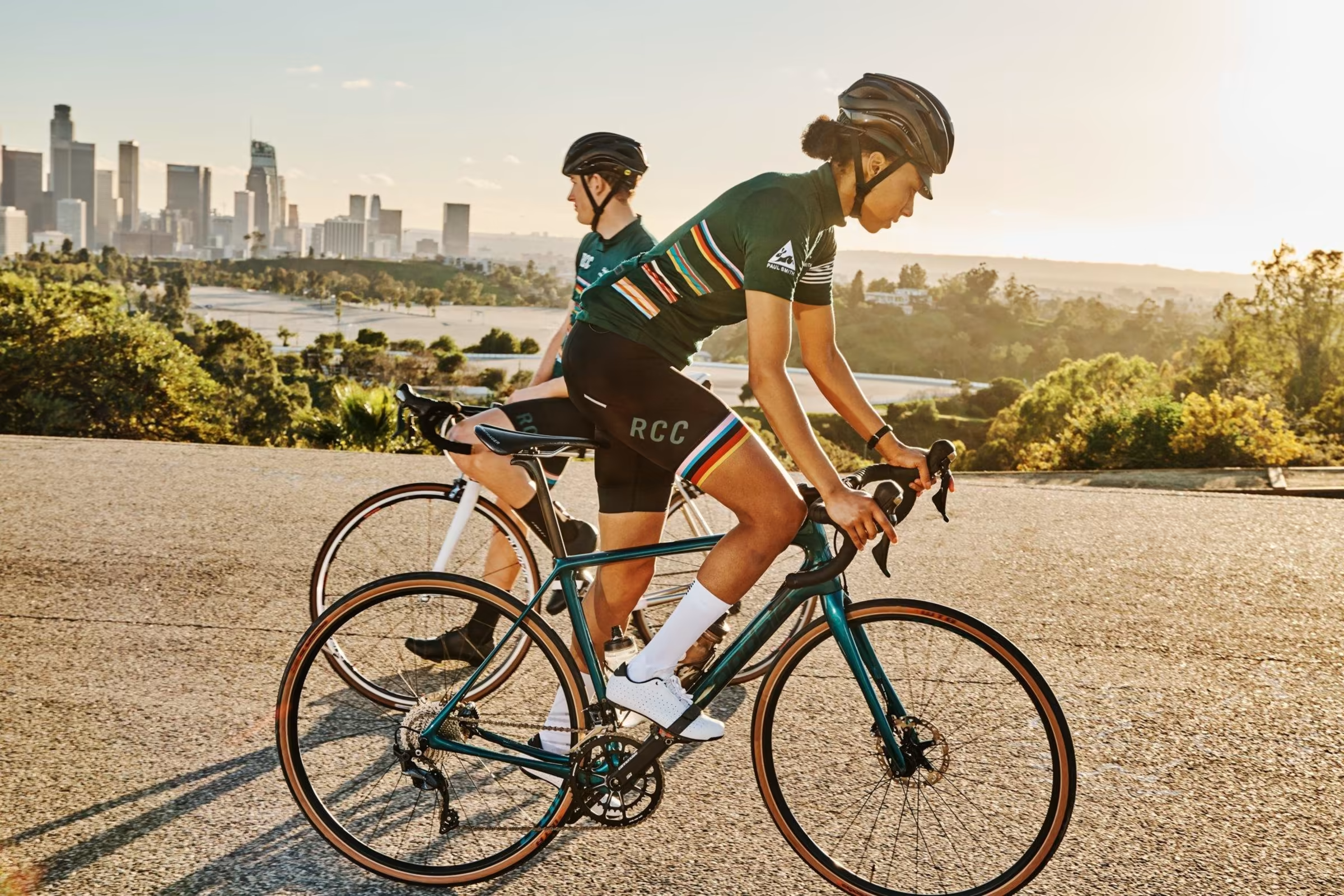
The company was Rapha, named for the St. Raphaël team of the 1950s and 60s, home of the legendary French rider Raphaël Géminiani, known as "le Grand Fusil" (the Great Rifle). The logo looked handwritten. The palette was crisp, and it included what would become the signature Rapha Pink (#FF058A). Even the asymmetric armband stripe on the debut Classic Jersey, a simple horizontal block of contrasting color, looked cool and had a purpose.
I have loved that brand for the last sixteen years, and that is exactly why this is hard to write.
The UK brand landed in the US exactly when American cycling needed something new to aspire to. In 2010 the sport was staring down doping scandals and a changing of the guard. Lance Armstrong rode his last Tour that year, finishing 23rd, before being wiped from the record books altogether. Alberto Contador, who famously feuded with Armstrong when they shared a team, later had his own win vacated.
People were still riding, though, and now they had an aspirational place to spend money. Before Rapha, most cycling apparel in the US was bland, lifeless, utility-first gear you bought at REI. One small design-forward brand in Minneapolis, Twin Six, made a dent, but it lacked the capital and the appetite to go mainstream.
Rapha had both. Founded in 2004 by Simon Mottram, a brand consultant with a taste for design, it had the means, the materials, and the momentum. Mottram has said that back at Pricewaterhouse he subscribed to Design Week and Blueprint, and that odd pairing of finance and taste shaped everything. Rapha's bet was that people would pay for better-made kit that made them look better, and the story around it mattered as much as the fabric it was made from.
Rapha did not plant its American flag in Boulder or Austin. It chose Portland and tapped former Nike brand standout Slate Olson to lead the US business (2008 to 2013, before he moved up to CMO). That choice told you the company saw itself as a design and culture brand first and a sports brand second.
Everything at Rapha was about the aesthetic, from that asymmetric left armband to Rapha Films, the ongoing documentary series covering races, women riders, solo rides, frame builders, and more. Mottram's vision rested on four insights:
- Cycling's history and culture were an untapped asset.
- E-commerce and direct-to-consumer sales were about to change how apparel got sold.
- Premium and luxury brands were gaining ground with people who used to buy on price.
- Customer experience was becoming the real product.
What made it work was the machinery built on top of those insights. Look closely and every piece is a belonging mechanic, a way to make an outsider feel like an insider and an insider like me feel chosen.
They did this through little bits of hard-to-get, coveted items:
The roundels. A small circle patch, 1.5 to 2 inches across, on the kit that other riders could clock at fifty yards. No explanation needed. If you knew, you knew. They were given out for challenges, races, and events, and you only got one by showing up and suffering for it.
The Rapha Cycling Club (RCC). A paid membership with real dues. The RCC gave you a jersey, a network, and a reason to show up in a city you had never visited. In 2015 I was member 1716, and had the card to prove it (which got me a free espresso drink in any Rapha Clubhouse), and by 2021 it had more than 20,000 members riding together around the world.
The custom RCC top tube caps. Absurdly specific gear for a small slice of owners. It signaled that Rapha knew its most devoted customer by name.
Mondial. The gorgeous, custom Rapha magazine that debuted in 2015 and often had RCC "inserts" featuring cycling club members from across the globe.
The events. Festive 500 asked you to ride 500 kilometers between Christmas Eve and New Year's Eve, in the cold, on purpose, then post proof. Rapha Continental sent riders on adventures. The Prestige and the Longest Day turned suffering into a shared ritual. The tagline and essence of the brand was: glory through suffering. And we did that, in style. Our Strava screenshots became our social currency of proof before other brands even knew about Strava.
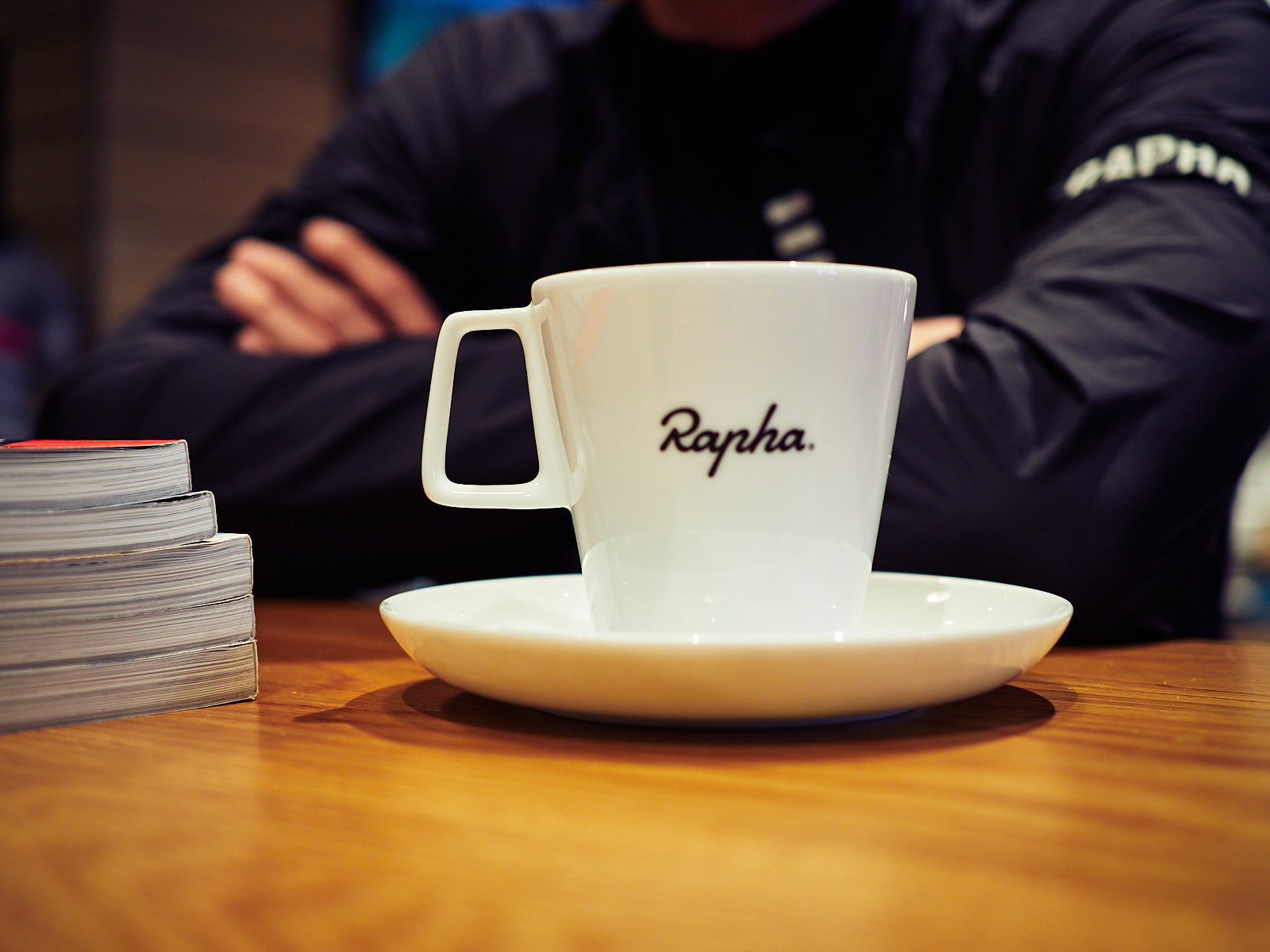
The Clubhouses and the coffee. Each one felt like a room you were allowed into, and the espresso was the admission ticket. The first few were purposeful and aspirational: London, NYC, Tokyo, San Francisco, Paris. If you were a traveling RCC member there was a brand new Canyon Ultimate CF SLX 9.0 waiting for you to "rent." I used the ones in Tokyo, London, and San Francisco about two dozen times. By the time of the sale, Rapha ran 17 Clubhouses internationally and was planning on expanding.
The collaborations. Partnerships with design-obsessed, premium-priced brands, including work with Canyon bikes, Bang & Olufsen, Paul Smith, Palace, streetwear label Patta, and more, borrowed credibility from companies that also sold taste.
Each of these is expensive to run and hard to scale past a certain number of customers without breaking what makes it valuable. Hold that thought.
With all these exciting collabs, races, and aspirational offerings, what went wrong?
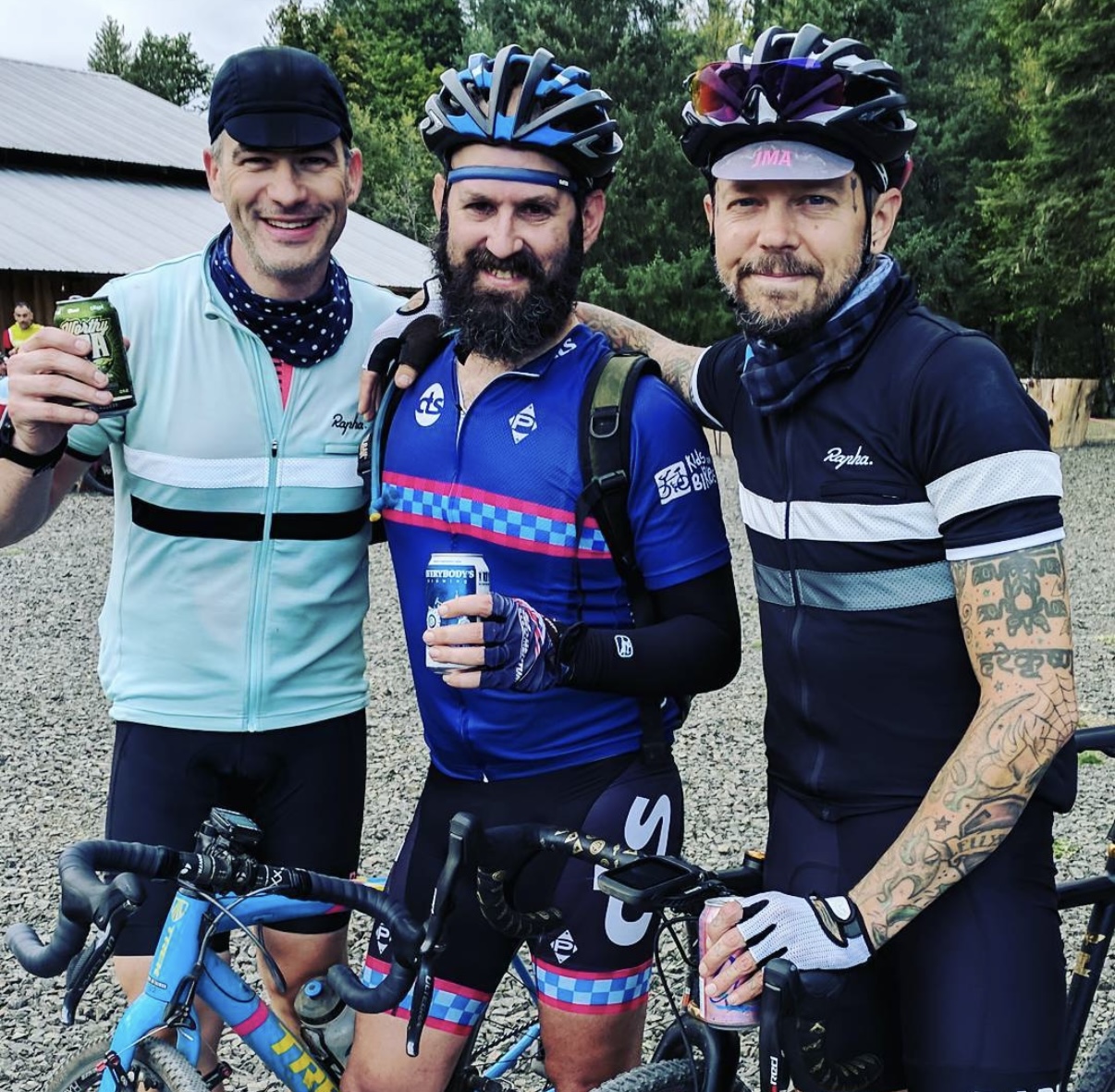
It started in the summer of 2017, when Rapha was up for sale. I had an insider look during this time as my then-company's British private equity owners wanted to throw their hat in the ring for a potential purchase. We offered a fair, over-asking price, but we didn't even pass the first cut. Then we found out why: in August 2017, RZC Investments, the private equity vehicle of Walmart heirs Tom and Steuart Walton, bought a majority stake in Rapha. The reported price was £200m, roughly $260m. We never had a shot. At the time Rapha had annual sales of £63m, 20 localized websites, and 17 Clubhouses. Mottram stayed on as CEO and kept a significant piece of his stake.
Now, the Waltons are genuine cyclists. Tom Walton helped drive the Walton Family Foundation's $13m investment in the mountain bike trail network around Bentonville, and RZC also held stakes in Allied Cycle Works and Wahoo Fitness. The buyer was a major fan with capital, which makes the rest of the story more interesting yet more uncomfortable.
The headline was "Discounter Walmart bought high-end Rapha." It just felt… off.
Their announcement promised a Clubhouse rollout, a bigger membership club, and global expansion. Read that list again with the previous section in mind. Every item on it asks a scarcity brand to become a volume brand. A price of that size comes with a growth expectation attached, and the fastest ways to grow an apparel company are lower price points, more retailers, and more sales promotions.
To be fair to the new owners, the drift started before they arrived. Rapha had already launched a lower-priced Core line in 2016, a year before the sale. After 2017 the playbook will look familiar to anyone who has watched a cult brand meet a buyout. Distribution widened to more retailers worldwide, and mountain bike apparel joined the range. Routine discounting crept in, and Rapha's own recent statements admit the business leaned way too hard on discounts and promotions. Mottram himself told the Evening Standard that future growth would mean slightly lower price points so more people could afford the brand. He insisted this would not dilute it. But it did. And that call belonged to the founder as much as to the money behind him.
I routinely heard friends say "I'll wait until the off season and buy it at 50% off."
Dilution is what happens when a brand built on "if you know, you know" starts telling everyone. A roundel is the opposite: something you earned.
Once the same logo sits in a wholesale window next to a sale tag, it stops working as a signal. I eventually cancelled my membership. The RCC kept plenty of members, sure, but the price of belonging kept getting cheaper.
The leadership churn tells the rest of the story: Mottram stepped down as CEO at the end of 2021 after 17 years. William Kim, formerly of AllSaints, left within a year. Two joint managing directors kept the lights on until Fran Millar, the former Team Sky and Ineos chief, arrived in August 2024. Millar just left in September 2026, with cost cuts and an organizational restructure on the table. Three successors in under five years is telling. And by Millar's own account the market noticed. "We would be naive to say we haven't lost a lot of market share," she told Cycling Weekly.
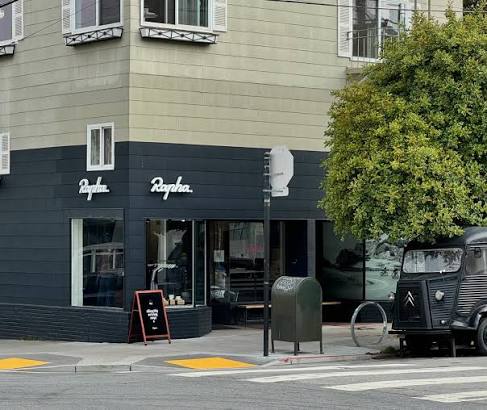
The geography didn't help. In 2020 Rapha moved its North American headquarters from Portland to Bentonville, Arkansas, the Walton hometown. Portland was a design town where Rapha hired a Nike guy (and later the amazing Head of US Hillary Benjamin). But Bentonville is a holding company address, and while the city's new cycling culture has a heck of a lot to thank the Waltons for, it was just a different vibe. Later, most US operations reportedly folded back toward London, and peripheral bets such as Rapha Travel were shut down.
The luster was eroding fast. Now everyone who wanted Rapha had it, the diehards stopped buying it, and the add-ons that made the brand aspirational were getting cut to save money.
The worst part? Every fiscal year since the sale has posted an operating loss, even the pandemic year when EBITDA briefly turned positive, and the trend line is the story. Figures below come from Rapha's filings as reported by the trade press. Loss measures differ by year, so read the notes on each one.
FY2026 (ending January): Turnover £89m. £21.2m operating loss, £5.6m EBITDA loss. Ninth straight year of operating losses.
FY2025: Turnover £96m. £15.6m net loss, £17.2m operating loss. Holding company Carpegna cut Rapha's carrying value from £169m to £67m.
FY2024: Turnover £110m. £22.7m pre-tax loss, £19.6m post-tax loss. Turnover down 7 percent.
FY2021: Turnover £98m. EBITDA of £13m, still an operating loss. Pandemic bike boom lifted sales from £74m.
FY2019: Turnover n/a. £32m loss. Largest loss in the period covered by the filings.
FY2017: Turnover £63m. £1.4m pre-tax profit. Sale to RZC. Roadman Cycling calls it the only profitable year on record.
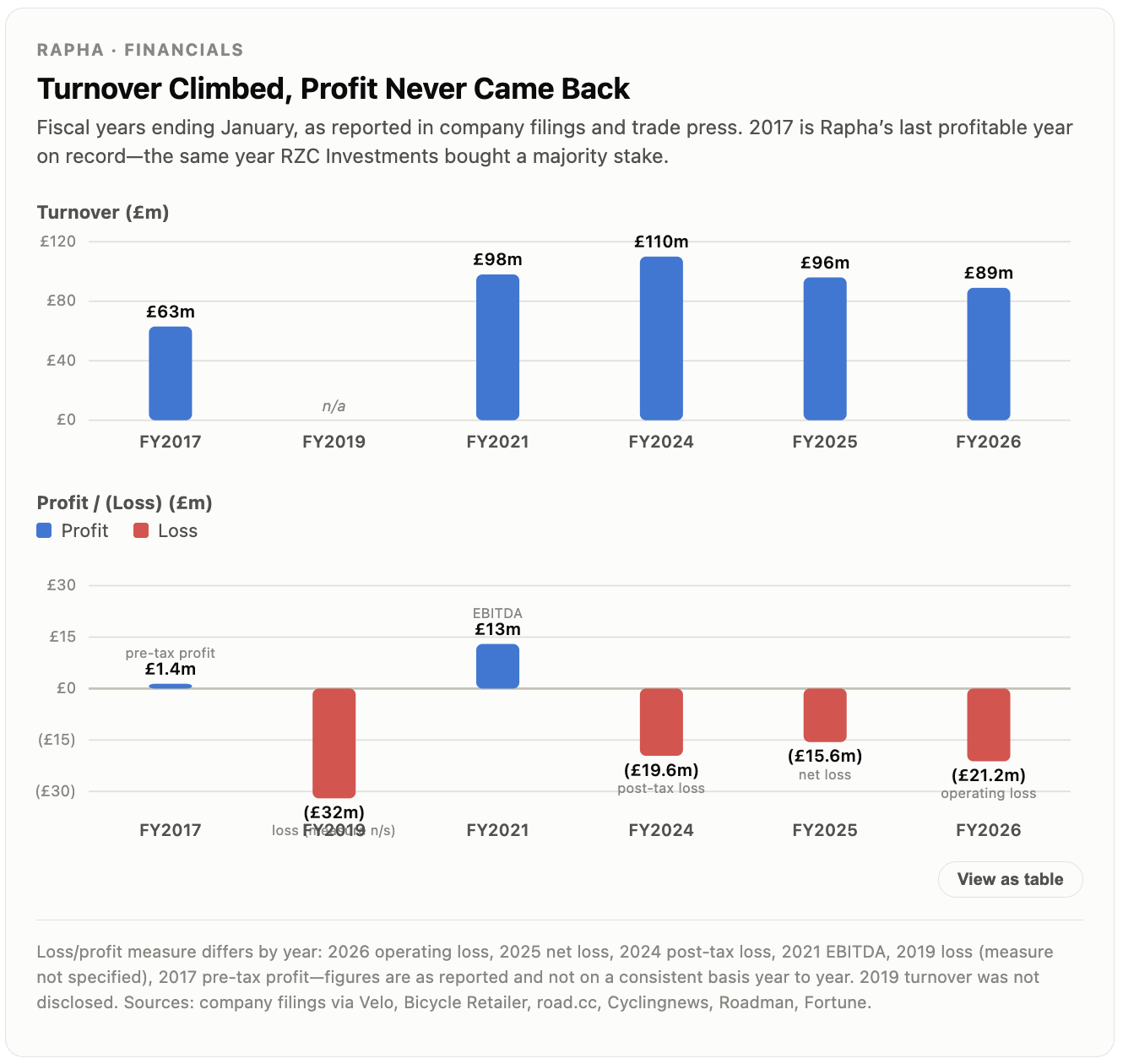
The bottom line is roughly £60m in losses across the last three years (the measures vary, and no version of the math looks good), a two-thirds write-down of the company's book value, and a turnover line that has slid from £110m to £89m. The 2021 bump deserves an asterisk. That year everyone bought bikes and kit, and Rapha's sales jumped almost a third, mostly from new riders. In the end, a pandemic tailwind masked the structural problem for one year and then left (like it did for a lot of cycling brands).
The ownership picture has shifted as well. In February 2026 Fortune reported that RZC paused all new investments after one of its two partners, Don Huffner, left the fund, and RZC said it was weighing the structure of future investing. Rapha says it is on a plan to reach sustainable profitability by 2027 and points to a customer lifetime value of £634 as a green shoot, but to get there, job cuts and a restructure are coming.
Here's my read, and you can argue with it of course: scarcity was the most valuable asset on Rapha's balance sheet (think Supreme or Nike SNKRS drops). Scarcity was what made the roundel worth earning and wearing, the RCC worth joining, and $200 bib shorts worth buying. A buyer paying £200m for that very asset gets a growth story attached, and the growth story then spends the asset down. The founder started the spending, and the new money sped it up. Supreme ran the same experiment at a bigger number: VF Corp paid $2.1B for it in 2020 and sold it to EssilorLuxottica for $1.5B four years later.
And the Walmart name stuck to all of it, fair or not.
Three lessons that go well beyond cycling: 1. Price the brand, then price the promise. If your valuation assumes volume, your brand promise had better survive volume. "Belonging" mechanics like clubs, rituals, and inside signals get weaker if you add new members who join at a discount.
- Tension at the top shows up in the racks. Bring in a new investor and you have two customers, the rider and the shareholder. When the shareholder's needs win the argument, the rider feels it first in the shop window.
- A great founder story is a wasting asset unless someone keeps writing it. Rapha went through a founder handoff and three successors in under five years. Nobody stayed long enough to defend the point of view, and the founder's story walked out the door with him.
I still love what it was. The pink still stops me cold (#realmenwearpink was often an IG tag). The best thing I can say about the brand today is that the playbook Mottram wrote in 2004 remains sound, but the current company has drifted from it. The 2027 profitability plan says Rapha wants to "invest in brand and product and lean less on discounts." If that is real, it is the right instinct. It just arrives roughly a decade too late. And if there's one thing I know about sales and pricing strategy… it's hard to get the genie back in the bottle. Getting past buyers to pay full price again is a hard sell. And new buyers have more choices than ever, thanks in part to the brands Mottram himself inspired.
I think about that doppio in NYC from time to time. In the last 16 years Mottram's style and design aesthetic has influenced my work in brand and design more than I've admitted to him. But that first encounter? The room was small, the coffee was great, and every person in it knew why they were there. And it spawned twenty thousand true believers just like me, and grew to a nine-figure valuation.
That feeling. That comfort. That emotional connection. It's all gone.
More photos
Kyle Duford, Founder & Editor, BRNDWIRE. More from Kyle →