Washington Just Flipped Blue. What this means for brands.
Democrats won the midterms and took the House, padded the Senate past 54 seats, and flipped the Texas governor's mansion for the first time in a generation. Here's what that actually means for your brand, your budget, and the next ten weeks before any of it takes effect.
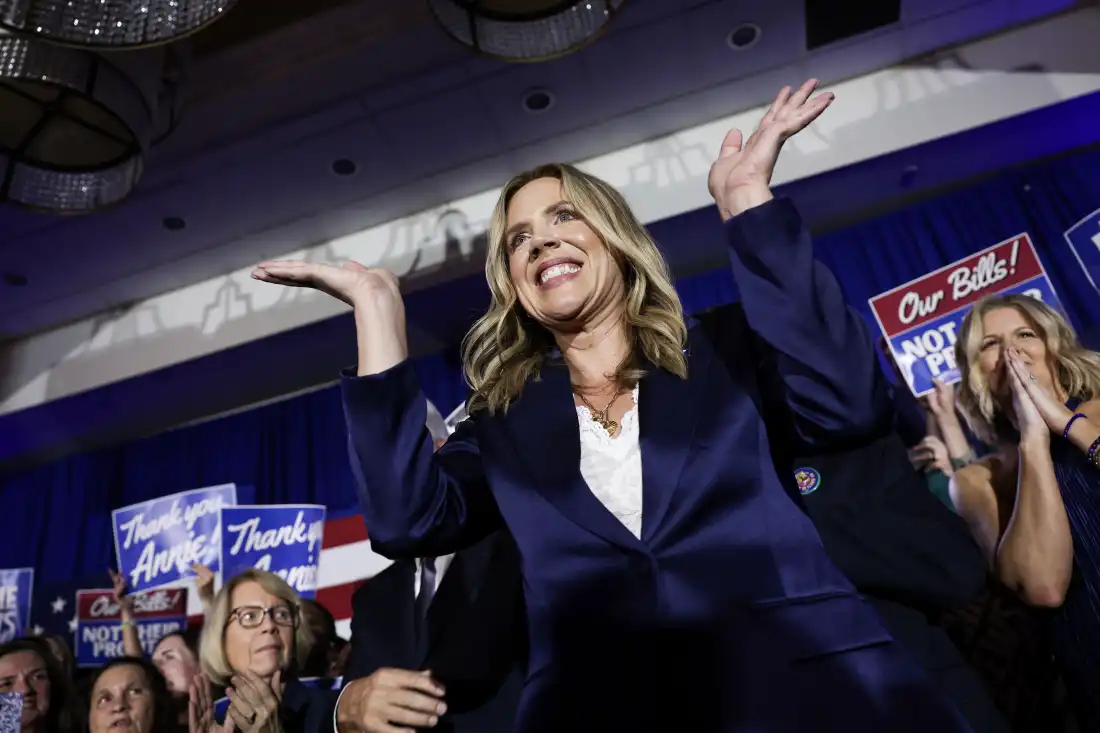
If your plan for a Democratic Congress was "wait and see what happens," you already lost two days of the runway you needed. The votes are counted, the market already repriced your sector overnight, and the brands that move first are going to look prescient in six months. The ones still scheduling a "wait and see" meeting are going to look like they were asleep at the wheel, because they were.
On Tuesday, Democrats won back the House, clearing the 218-seat threshold the Associated Press calls the "magic number." Republicans went in holding a 53-47 majority and came out the other side having lost at least seven seats, with Democrats confirmed winners in Kansas, Iowa, Ohio, Texas, Maine, Alaska, and South Carolina trending the same direction as the count finished. Michigan, the one seat Republicans actually thought they could flip, stayed exactly where it was, because Abdul El-Sayed held it for the Democrats. Hakeem Jeffries, who is about to become Speaker of the House, stood up Wednesday morning and said "America is back." He wasn't being modest.
And then there's Texas. Greg Abbott lost. A Democrat named Gina Hinojosa is now the governor-elect of Texas, the first Democrat to hold that job in roughly three decades and the first Latina to hold it ever, and she won it in part by running directly at the AI data center boom, promising a moratorium on new builds. If you work in brand strategy and you didn't flag that sentence, read it again. The thing that just unseated a four-term Republican governor in Texas wasn't abortion or guns or immigration. It was data centers. The physical, humming, water-guzzling infrastructure behind every AI pitch deck your agency has shipped this year just became a kitchen-table political issue in the reddest state that still matters, and it worked.
The market already told you what matters, you just have to read it like a brand person instead of a trader
Wall Street? No nuance. Overnight, Nasdaq 100 futures fell as much as 2.4% before clawing back to a 0.4% loss by morning, and the sector getting hit hardest wasn't semiconductors generally, it was anything tied to the AI data center buildout specifically. One broker estimate making the rounds puts 13.3 gigawatts of planned US data center capacity at risk of stricter local scrutiny now that roughly half the pipeline sits in places where the politics just shifted under it. Tesla and SpaceX both dropped about 1.8% in after-hours trading, which has nothing to do with either company's actual numbers and everything to do with the fact that Elon Musk spent the last two years as the most visible brand ambassador the Trump administration had. Meanwhile, solar stocks rallied hard, with Hanwha Solutions up as much as 10%, because the market reads a Democratic sweep as a tailwind for renewables the same way it reads a Republican sweep as a tailwind for drillers. The dollar weakened against every G10 currency. Gold jumped 2.3% to $4,021 an ounce. Bitcoin dipped to a seven-week low on fears that a Democratic Congress stalls the industry-friendly crypto legislation that was finally gaining traction, then clawed most of it back by morning. Treasuries rallied, with the 10-year yield dropping to 4.93%, because bond traders read divided government as "harder to pass deficit-expanding legislation," which is their polite way of saying gridlock is a feature, not a bug, if you're worried about the debt.
None of that is a political opinion. That's just what capital did with its own money in the first twelve hours. If you want a free, real-time referendum on which sectors just got more dangerous and which just got safer, you already have it, and it updates every fifteen minutes. The brand lesson underneath it is simple: perception of political exposure is now a line item on your balance sheet whether you asked for it or not, and the companies treating their CEO's public political alignment as a personal hobby rather than a brand risk are the ones whose stock moved 1.8% overnight for reasons that have nothing to do with their quarter.
You have about ten weeks before any of this actually bites
Nothing changes yet. The current, Republican-controlled Congress is still in session until the new one is sworn in on January 3, 2027. That cuts both ways. For Republicans, it's the last chance to push through anything that needs to clear both chambers before the gavels change hands, whether that's judicial confirmations, a tax provision, or anything else sitting in a drawer marked "do this before the music stops." For everyone else, it's a two-month runway to get your house in order before committee chairs change, subpoena power changes hands, and oversight hearings that were theoretical for the last two years become a scheduling problem for your general counsel.
This is the single most actionable thing in this whole piece, so I'm going to say it plainly: if you are in AI infrastructure, crypto, fossil fuel extraction, or anything that depends on a friendly regulator staying friendly, the next ten weeks are a deadline. Get your disclosures tightened. Get your crisis comms plan for "a hostile committee chair with subpoena power" actually written down instead of assumed. If your government affairs team's entire 2027 plan is a single slide that says "monitor the situation," that slide is why you're going to get surprised in March.
The specific fights that are about to land on your desk
AI and Big Tech. Democratic control of the House means Democratic control of committee gavels, which means subpoena power over the AI buildout's two biggest pressure points: energy consumption and labor displacement. Hinojosa's win in Texas isn't an isolated local story, it's a preview. Every state with a competitive governor's race in 2027 and 2028 just watched "I'll stop the data center near your house" work as a closing argument. If your company's growth model depends on nobody noticing how much water and power a hyperscale campus actually uses, that assumption just got a lot more expensive to hold.
Energy and climate. The solar rally wasn't subtle, and it's going to feed a boardroom conversation a lot of brands have been quietly avoiding since ESG became a word people flinched at saying out loud. Sustainability messaging is about to come back into fashion, and I mean that the way flared jeans come back into fashion: everyone already owns a pair, nobody wants to admit it, and suddenly it's cool again. The brands that quietly shelved their climate commitments over the last two years without actually unwinding the underlying work have an opportunity here, but only if they can produce receipts. The ones that shelved the commitments and the work together are about to get caught performing a reversal they can't back up, which is a much worse look than never claiming it at all.
Crypto and fintech. The industry spent three years and an enormous amount of money buying itself a friendly regulatory environment, and Bitcoin's overnight dip to a seven-week low is the market pricing in the risk that a Democratic Senate slow-walks the market-structure legislation the industry was counting on. That doesn't mean it dies. It means the lobbying budget that was aimed at "get this passed" now has to be rebuilt around "get this passed with people who weren't in the room when we wrote it," which is a different, slower, more expensive conversation.
Taxes, but not the way you think. This is the part that should make every brand strategist sit up, because it's counterintuitive and it's the best evidence in this whole election that "Democrats swept" does not automatically mean "every progressive economic idea wins." California, the bluest state in the country, had its own billionaire wealth tax on the same ballot, Proposition 40, a one-time 5% levy that Meta's board had actually structured a deal to help Mark Zuckerberg cover if it passed. It failed, and it didn't fail narrowly. Early counts had it losing by something like 56% to 44%, after Google co-founder Sergey Brin alone put more than $100 million into the opposition campaign. Think about what that means: on the same night California voters were sending a message to Washington, they looked at a direct, specific, "tax the three richest people in the state" measure and said no, thanks, by a double-digit margin. The lesson for your brand isn't "business can buy any election it wants," because $100 million buying a double-digit win on a single-state ballot measure is not a universal law, it's a specific, well-funded, well-targeted campaign against an unusually narrow tax. The actual lesson is softer and more useful: voters can hand Democrats the House, the Senate, and the Texas governor's mansion in the same breath they reject a punitive-sounding wealth tax, which means the "business versus populism" framing most brand crisis plans are built around is lazier than the electorate actually is. Don't assume you're the villain in every story just because the chamber flipped.
Labor. Don't expect the PRO Act to suddenly clear a Senate that still needs sixty votes to beat a filibuster, because it won't. What you should expect instead is louder, better-staffed committee hearings on labor practices at exactly the companies that have spent the last few years treating union avoidance as a core competency rather than a controversy. The NLRB's composition shifts slowly, but the oversight hearings happen fast, and a hearing doesn't need to produce legislation to produce a news cycle that follows your brand around for a month.
Healthcare and pricing. Drug pricing negotiation, insurer scrutiny, and PBM transparency were already bipartisan-ish before this election. They're about to become a lot more bipartisan, in the sense that Democrats will push harder and Republicans in competitive districts will have a much stronger incentive to co-sign rather than look obstructionist heading into 2028. If your brand touches pharma, insurance, or anything with "surprise billing" in its Wikipedia controversy section, this is not a drill.
The Fed, quietly, in the background. Senate Democrats can now block any Trump nominee to the Federal Reserve, which sounds like inside-baseball until you remember that monetary policy uncertainty is the thing that actually moves your cost of capital. A contested Fed, even one that isn't formally "contested" in any constitutional sense, trades at a premium of uncertainty that shows up in every rate-sensitive line item on your P&L. This is the least sexy item on this list and probably the one with the longest tail.
What to actually do with all of this
I'm not going to give you the version of this advice that says "stay agile" and "monitor developments," because that's the brand-strategy equivalent of a doctor telling you to "eat healthier" without naming a single food. Here's the actual list.
- Separate your political exposure from your product exposure, and be honest about which one is driving the stock move or the brand sentiment hit you're worried about. Tesla dropping 1.8% overnight had nothing to do with a single car it sold. If your brand has a visible, politically coded figurehead, model the specific scenario where that person becomes the story instead of the product, because that scenario just got meaningfully more likely for an entire category of companies, not just the obvious one.
- If you're anywhere near the AI data center supply chain, whether you're the hyperscaler, the utility, the construction firm, or the chip maker three steps removed, build your local-community narrative now, before a candidate in your market builds it for you the way Hinojosa just did in Texas. "We bring jobs" is not a defense anymore. It wasn't enough in Texas, and Texas was supposed to be the easiest sell in the country for that argument.
- If you shelved sustainability messaging because it got politically inconvenient, do the audit now, quietly, before it's fashionable again and everyone's watching for hypocrisy. You want to be ready to talk about this with receipts in hand, not scrambling to write the receipts after the fact.
- Use the ten-week window. Government affairs teams that treat this transition period as dead time between elections are the ones who get blindsided by a January hearing they should have seen coming in November. The committee assignments aren't a surprise. The chairs aren't a surprise. The only surprise is whichever brand didn't bother to read the writing on the wall while it was still just writing and not yet a subpoena.
- Resist the temptation to treat this election as a simple morality play where business lost and populism won, because the Proposition 40 result is sitting right there to prove that framing wrong on the same ballot, in the same state, on the same night. The electorate just proved it's perfectly capable of punishing a party at the federal level while rejecting that same party's flagship state-level economic idea by double digits. That's not contradiction, that's nuance, and nuance is exactly the kind of thing a good brand strategy is supposed to be built to survive. The brands that read this moment as "crisis" are going to overcorrect. The ones that read it as "the rules changed, so update the playbook" are going to be the only ones still standing when the next cycle does this all over again.
Washington flipped. The invoice isn't due yet. You've got until January to make sure you can actually pay it.
Kyle Duford, Founder & Editor, BRNDWIRE. More from Kyle →
The Brand Briefing
Liked this? Get five more every morning.
The Brand Briefing: the stories moving brands, in your inbox at 7am your time. Free.